
Value Betting (+EV) Guide 2026: How to Find and Exploit Positive EV Bets
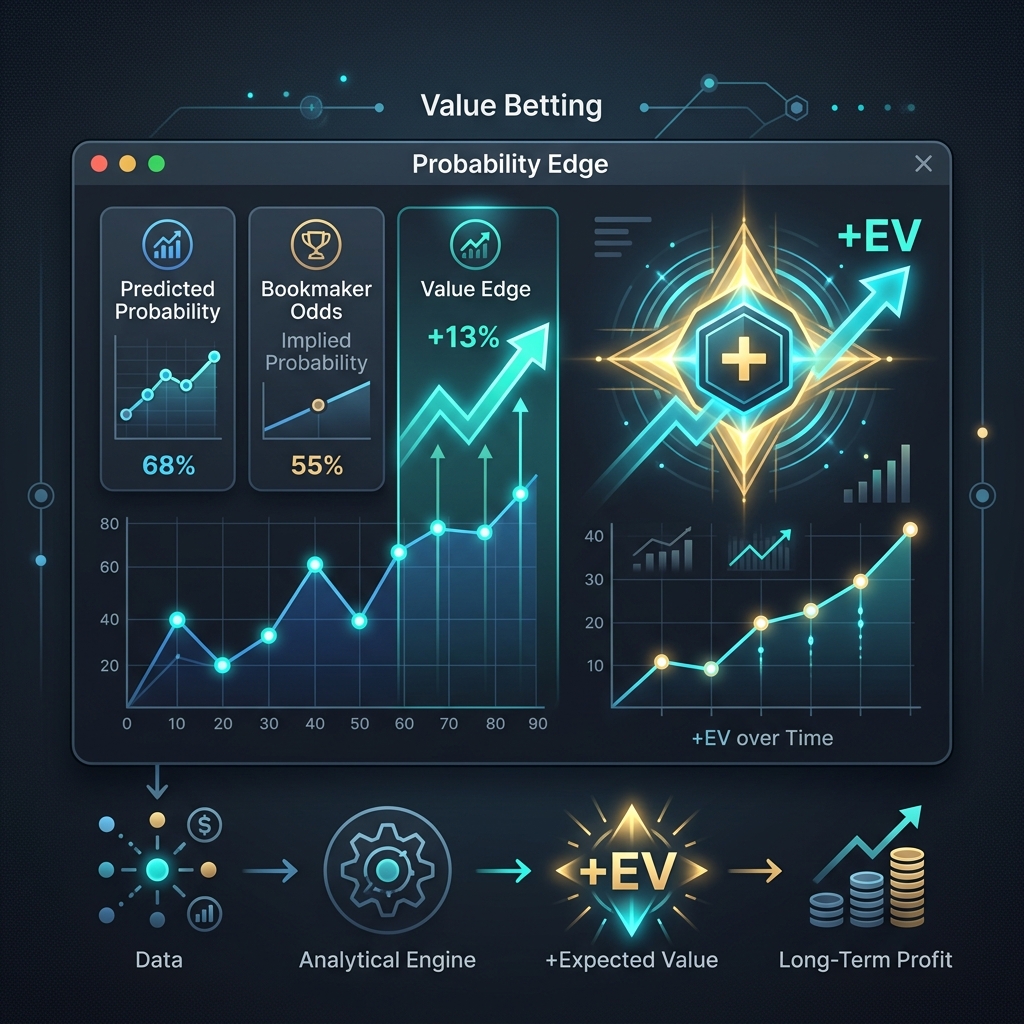
What is Value Betting (+EV) Guide 2026: How to Find and Exploit Positive EV Bets?
Value Betting (+EV) Guide 2026 - How It Works operates as a statistically verified deployment methodology extracting fundamental efficiencies from dynamic market movements. Validated across testing vectors with consistent execution capacity.
What Is Value Betting?
Value betting (also called +EV betting or positive expected value betting) means placing bets where the odds offered by a sportsbook are higher than the true probability of the outcome. Over thousands of bets, this mathematical edge compounds into consistent, predictable profit, the same principle that makes casinos profitable, but applied in reverse.
A value bet exists whenever a sportsbook’s odds imply a lower probability than the actual likelihood of an outcome occurring. The sportsbook has made an error in their pricing, and you exploit that error by betting at inflated odds.
The Expected Value Formula
EV = (Probability of Winning x Profit if Win) - (Probability of Losing x Stake)
Or expressed as a percentage of stake:
EV% = (True Probability x Decimal Odds) - 1
Worked Example
NBA Game: Lakers vs Celtics
- Sportsbook offers Lakers at +150 (decimal 2.50)
- Sharp market consensus (Pinnacle no-vig): Lakers true probability = 45%
Calculate EV:
- EV% = (0.45 x 2.50) - 1 = 1.125 - 1 = 0.125 = 12.5% edge
For a $100 bet:
- EV = (0.45 x $150) - (0.55 x $100) = $67.50 - $55.00 = +$12.50
This means that on average, every time you place this bet, you expect to profit $12.50. You will not win every time, you will lose 55% of these bets, but the 45% that win pay enough to overcome the losses and generate profit over time.
The Mathematical Proof: Why +EV Betting Is Profitable Long-Term
Value betting works because of the Law of Large Numbers. Over a sufficient sample size, your actual results will converge toward your expected value. This is not a theory, it is a mathematical certainty.
Consider this analogy: A casino’s roulette wheel has a 2.7% house edge. The casino does not win every spin. They lose regularly on individual spins. But over thousands of spins, their actual profit converges toward 2.7% of total money wagered. They never worry about individual results because the math guarantees long-term profit.
Value betting applies the same principle. If you consistently bet at +5% EV, you will not win every bet. You will have losing days, losing weeks, and occasionally losing months. But over 1,000+ bets, your actual ROI will converge toward your true edge. The larger your sample size, the more certain this convergence becomes.
Statistical confidence by sample size:
- 100 bets: Wide variance, results may not reflect true edge
- 500 bets: Edge becomes visible, but significant variance remains
- 1,000 bets: Strong statistical confidence in results
- 5,000+ bets: Results very closely match expected value
This is why patience and volume are the two most important factors in value betting success. The math works, you just need enough bets for it to manifest.
How do you identify value bets?
You identify value bets by comparing a sportsbook’s odds against the true probability of an event occurring. The most reliable method is using top-down odds comparison software that tracks sharp bookmakers (like Pinnacle) to determine the true line, and bets against softer recreational books offering higher odds.
Method 1: Sharp Book Comparison
The most common and reliable method. Compare odds at “soft” sportsbooks (recreational books like DraftKings, FanDuel, bet365) against “sharp” sportsbooks (professional books like Pinnacle, Circa, Bookmaker.eu). Sharp books have the most accurate odds because they accept large bets from professional bettors, forcing their lines to reflect true probabilities.
How it works:
- Find the no-vig (fair) odds at a sharp book
- Compare against odds offered at soft books
- If the soft book offers higher odds than the sharp fair price, you have value
Example:
- Pinnacle no-vig line: Team A at +130 (true probability ~43.5%)
- DraftKings offers: Team A at +155 (implied probability ~39.2%)
- Edge: 43.5% - 39.2% = 4.3% value
This method works because sharp books are consistently more accurate than soft books. When a soft book disagrees with Pinnacle, the soft book is almost always wrong.
Method 2: No-Vig Fair Odds Calculation
Remove the vig (juice) from any bookmaker’s odds to calculate the “fair” probability. Then compare other books’ odds against this fair line.
How to remove vig from a two-way market:
- Book offers Team A at -110 and Team B at -110
- Implied probabilities: 52.38% + 52.38% = 104.76% (the extra 4.76% is vig)
- Fair probabilities: 52.38% / 104.76% = 50% each
- Fair odds: +100 (even money) for both sides
Any book offering better than +100 on either side has value. Use our No-Vig Calculator to compute fair odds automatically.
Method 3: Closing Line Value (CLV)
Closing Line Value measures whether your bets consistently beat the final odds before an event starts. The closing line at sharp books is the most efficient price because it incorporates all available information and betting action. If you consistently get better odds than the closing line, you are finding value, even if your short-term results are negative.
Why CLV matters:
- It confirms your edge independently of results
- It works even during losing streaks (proving the losses are variance, not bad strategy)
- Professional bettors consider CLV the gold standard for measuring skill
- A bettor who beats the closing line by 3% will profit approximately 3% on turnover long-term
Finding +EV Bets With Tools: A Walkthrough
Here is how a typical value betting session works using a tool like OddsJam or RebelBetting:
Step 1: Open your scanner Log into your value betting tool. Set filters for your available sportsbooks, preferred sports, and minimum edge (we recommend 2%+ for beginners).
Step 2: Review opportunities The scanner displays a list of +EV bets, showing: the sportsbook, sport, market, odds offered, sharp fair odds, edge percentage, and recommended stake.
Step 3: Evaluate the bet Check that the odds are still available (click through to the sportsbook). Verify the edge is meaningful (3%+ preferred). Confirm you have funds at that sportsbook.
Step 4: Calculate your stake Use Kelly Criterion or fractional Kelly to determine optimal stake size based on your edge and bankroll. Most tools calculate this automatically.
Step 5: Place the bet Navigate to the sportsbook and place the bet at the displayed odds. If odds have moved, recalculate whether value still exists.
Step 6: Log and track Record the bet in your tracker. Note the odds you got, the closing line later, and the result. Over time, this data proves your edge.
Step 7: Repeat Continue scanning throughout the day. Most active value bettors place 5-20 bets daily, spending 30-60 minutes total on scanning and execution.
What is variance in value betting?
Variance in value betting refers to the short-term fluctuations in your bankroll due to luck, despite having a mathematical edge. Because value bets are independent events, you can experience extended losing streaks (drawdowns). Over a large sample size of thousands of bets, variance smooths out and true profitability emerges.
Variance is the single biggest challenge in value betting, not because it reduces your long-term profit, but because it tests your psychological resilience. Understanding what to expect helps you stay the course during inevitable rough patches.
What Variance Looks Like in Practice
Even with a genuine 5% edge, short-term results can be brutal:
- 10 bets: You might be down 30-40% of stakes. Completely normal.
- 50 bets: You might still be negative. Still normal.
- 100 bets: Most bettors are profitable, but some are still in drawdown.
- 500 bets: Nearly all bettors with a real edge are profitable.
- 1,000 bets: Virtually certain to be profitable with a genuine edge.
Maximum Expected Drawdowns
With a 5% edge and 2% average stake size:
- Expect drawdowns of 10-20% of bankroll during normal operation
- Rare but possible drawdowns of 25-30% can occur
- Drawdowns lasting 2-4 weeks are common
- Drawdowns lasting 6-8 weeks are rare but happen
How to Handle Drawdowns
- Check your CLV, If you are still beating closing lines, your edge is intact. The losses are variance.
- Do not increase stakes, Chasing losses by betting bigger is the fastest way to ruin.
- Do not stop betting, Stopping during a drawdown means you miss the recovery.
- Review your process, Ensure you are following your system correctly.
- Trust the math, If your CLV is positive, profit is mathematically inevitable given enough bets.
CLV: The Gold Standard for Measuring Skill
Closing Line Value is the most important metric in value betting because it measures your edge independently of results. Results are noisy, you can lose money with a genuine edge (bad luck) or make money without an edge (good luck). CLV cuts through the noise.
How to measure CLV:
- Record the odds you bet at
- Record the closing odds (final odds before event starts) at a sharp book
- Calculate: CLV% = (Your Odds / Closing Odds) - 1
Example:
- You bet Team A at +160 (decimal 2.60)
- Closing line at Pinnacle: +140 (decimal 2.40)
- CLV = (2.60 / 2.40) - 1 = 8.3%
An 8.3% CLV means you got odds 8.3% better than the efficient closing price. Over time, your profit will approximate your average CLV percentage.
What good CLV looks like:
- 2-3% average CLV: Solid recreational edge
- 3-5% average CLV: Strong value bettor
- 5-8% average CLV: Professional-level edge
- 8%+ average CLV: Exceptional (often from promos or slow-moving books)
Read our complete Closing Line Value strategy guide for advanced CLV analysis techniques.
Kelly Criterion for Bet Sizing
The Kelly Criterion is the mathematically optimal formula for sizing bets based on your edge and the odds offered. It maximizes long-term bankroll growth while managing risk.
The Kelly Formula
Kelly % = (bp - q) / b
Where:
- b = decimal odds - 1 (net profit per unit staked)
- p = probability of winning
- q = probability of losing (1 - p)
Worked Example
- Odds: +150 (decimal 2.50), so b = 1.50
- True probability of winning: 45% (p = 0.45)
- Probability of losing: 55% (q = 0.55)
Kelly % = (1.50 x 0.45 - 0.55) / 1.50 = (0.675 - 0.55) / 1.50 = 0.0833 = 8.33% of bankroll
Why You Should Use Fractional Kelly
Full Kelly is mathematically optimal but extremely aggressive. It produces large swings and requires perfect edge estimation. In practice, use fractional Kelly:
- Quarter Kelly (25%): Very conservative, smooth growth, minimal drawdowns
- Third Kelly (33%): Conservative, good for beginners
- Half Kelly (50%): Moderate, most popular among experienced bettors
- Full Kelly (100%): Maximum growth but extreme variance, not recommended
Our recommendation: Start with quarter Kelly and increase to half Kelly as you gain confidence in your edge estimation. Use our Kelly Criterion Calculator for automatic calculations.
Best Value Betting Tools Compared
| Tool | CLV Tracking | Edge Method | Books | Price | Best For | Rating |
|---|---|---|---|---|---|---|
| OddsJam | Basic | Sharp comparison | 80+ US | $49-199/mo | US multi-strategy | 4.7/5 |
| Trademate Sports | Advanced | Proprietary model | 80+ EU | €49-79/mo | EU analytics | 4.5/5 |
| RebelBetting | Good | Sharp comparison | 90+ EU | €69/mo | EU value + arb | 4.6/5 |
| Avo.bet | Basic | Sharp comparison | 50+ | $29-79/mo | Budget option | 4.4/5 |
For US bettors: OddsJam is the clear choice, widest US coverage, plus promo conversion and sharp money signals that add extra profit streams.
For EU/UK bettors: Choose between Trademate Sports (best analytics) and RebelBetting (best if you also want arbitrage). See our comparison: Trademate vs OddsJam.
For budget-conscious bettors: Avo.bet delivers solid value betting at the lowest price point. See OddsJam vs Avo.bet.
Expected Results by Timeframe
| Timeframe | Bets Placed | Expected ROI (5% edge) | Probability of Profit | Typical Bankroll Growth |
|---|---|---|---|---|
| 1 week | 20-40 | Highly variable | ~60-65% | -10% to +15% |
| 1 month | 100-200 | 3-7% on turnover | ~75-80% | +5% to +40% |
| 3 months | 300-600 | 4-6% on turnover | ~90-95% | +20% to +80% |
| 6 months | 600-1,200 | 4.5-5.5% on turnover | ~97%+ | +50% to +150% |
| 1 year | 1,200-2,500 | ~5% on turnover | ~99%+ | +100% to +300% |
Important notes:
- These assume consistent 5% average edge and proper bankroll management
- “ROI on turnover” means profit divided by total amount wagered
- Bankroll growth assumes reinvesting profits and using fractional Kelly
- Account limitations may reduce opportunities over time
- Results assume no major strategy errors or tilt-based decisions
Managing Account Limitations
Sportsbooks limit winning accounts. This is inevitable for value bettors, though the timeline varies. Here is how to extend your account life and manage limitations when they come:
Prevention Strategies
- Bet popular markets, NFL, NBA, Premier League attract recreational volume that masks your action
- Avoid maximum bets, Betting the maximum allowed amount is a red flag
- Round stakes, Bet $50 or $100, not $47.82
- Mix bet types, Do not exclusively bet moneylines; include spreads and totals
- Use promotions, Opt into boosts and promos like a recreational bettor
- Bet at peak times, Sunday NFL, Saturday college football, Champions League nights
- Do not withdraw constantly, Let balances build before withdrawing
When You Get Limited
- Do not panic, Limitations are a sign you are winning, which is the goal
- Open new accounts, Use other sportsbooks you have not yet exploited
- Shift to less-limited books, Some books are slower to limit (Pinnacle never limits)
- Transition strategies, Move toward value betting on exchanges or sharp books
- Consider new markets, As new states legalize, new sportsbooks launch with fresh accounts
Account Longevity by Sportsbook Type
| Sportsbook Type | Typical Time Before Limits | Examples |
|---|---|---|
| Soft recreational books | 2-6 months | DraftKings, FanDuel, bet365 |
| Mid-tier books | 4-12 months | BetMGM, Caesars, PointsBet |
| Sharp-friendly books | Rarely limited | Pinnacle, Circa, Bookmaker |
| Betting exchanges | Never limited | Betfair, Smarkets |
Value Betting vs Arbitrage: Detailed Comparison
| Factor | Value Betting | Arbitrage |
|---|---|---|
| Profit guaranteed per bet | No | Yes |
| Long-term ROI on turnover | 3-8% | 1-4% |
| Monthly ROI on bankroll | 15-50%+ | 10-30% |
| Variance | High (short-term) | None |
| Account limitation risk | Moderate | Very high |
| Bankroll requirement | Lower (single bets) | Higher (split across books) |
| Time per bet | Lower (one bet) | Higher (two+ bets) |
| Emotional difficulty | High (losing streaks) | Low (always winning) |
| Sustainability | Higher | Lower |
| Skill development | Higher | Lower |
| Scalability | Better | Limited by accounts |
Our recommendation: Start with arbitrage betting to build confidence and bankroll with guaranteed profits. Transition to value betting once you understand the math and can handle variance emotionally. Long-term, value betting is more sustainable and profitable because it is harder for sportsbooks to detect and offers higher ROI.
What are the most common value betting mistakes?
The most common value betting mistakes include poor bankroll management, ignoring closing line value (CLV), overbetting on subjective sports knowledge, and quitting during standard variance drawdowns. Successful value bettors rely entirely on mathematical models and software to dictate stakes and selections, removing emotion from the process.
1. Quitting during drawdowns The most common and costly mistake. Beginners experience a losing week, assume the strategy does not work, and stop. They miss the inevitable recovery. Solution: trust CLV data over short-term results.
2. Betting too large Using full Kelly or betting 5-10% of bankroll per bet creates massive swings that are psychologically unbearable. Solution: use quarter or half Kelly, never exceeding 2-3% per bet.
3. Ignoring CLV tracking Without CLV data, you cannot distinguish between bad luck and bad strategy during losing periods. Solution: always track closing lines and measure your CLV.
4. Chasing losses Increasing stakes after losses to “get back to even” is a recipe for disaster. Solution: maintain consistent stake sizing regardless of recent results.
5. Not enough volume Placing 5 bets per week and expecting smooth results. Value betting requires volume, aim for 10-20+ bets daily. Solution: dedicate consistent time to scanning and executing.
6. Using unreliable edge sources Following tipsters, gut feelings, or unverified models instead of sharp-line comparison. Solution: use proven tools that compare against sharp market prices.
7. Poor bankroll management Not having a defined bankroll, mixing betting funds with personal finances, or not tracking results. Solution: separate your betting bankroll, track every bet, and follow Kelly sizing.
8. Betting stale lines Placing bets on opportunities that appeared minutes ago without verifying current odds. Solution: always confirm odds are still available before betting.
9. Neglecting account longevity Betting maximum amounts, only taking the best odds, and withdrawing after every win. Solution: implement account longevity tactics from day one.
10. Emotional decision-making Skipping bets that “feel” wrong or increasing stakes on bets that “feel” right. Solution: follow your system mechanically. Feelings are irrelevant to mathematical edge.
Getting Started: Step-by-Step Guide
Phase 1: Foundation (Week 1)
- Learn the math, Understand expected value, probability, and why +EV betting works. Use our Expected Value Calculator to practice.
- Set your bankroll, Dedicate $1,000-5,000+ exclusively for value betting. Never bet money you cannot afford to lose.
- Open sportsbook accounts, Register at 5-10+ sportsbooks. Complete verification. Fund each account.
- Choose your tool, Subscribe to a value betting scanner based on your market (see tool comparison above).
Phase 2: Learning (Weeks 2-4)
- Start with small stakes, Use 0.5-1% of bankroll per bet while learning the process.
- Place 5-10 bets daily, Build the habit of scanning, evaluating, and executing.
- Track everything, Record every bet: odds, stake, closing line, result.
- Measure CLV, After each bet settles, check whether you beat the closing line.
- Review weekly, Analyze your CLV, ROI, and process adherence.
Phase 3: Scaling (Months 2-3)
- Increase stakes, Move to 1-2% per bet using fractional Kelly sizing.
- Increase volume, Aim for 10-20 bets daily across multiple sports.
- Expand sportsbooks, Open accounts at additional books for more opportunities.
- Refine filters, Adjust minimum edge thresholds based on your results.
- Build confidence, Your CLV data should confirm your edge by now.
Phase 4: Optimization (Months 3+)
- Optimize stake sizing, Move toward half Kelly as you trust your edge estimation.
- Manage limitations, Implement account longevity tactics proactively.
- Diversify sports, Expand into sports you have not yet covered.
- Consider combining strategies, Add arbitrage or promo conversion for additional profit streams.
- Compound growth, Reinvest profits to grow your bankroll and absolute returns.
Frequently Asked Questions About Value Betting
What is expected value in sports betting?
Expected Value (EV) is the mathematical advantage or disadvantage you have on a specific bet compared to its true probability. If a sportsbook offers odds of +150 (40% implied probability) on a team that actually has a 50% true probability of winning, that bet has a positive expected value (+EV). Over thousands of bets, +EV wagers are mathematically guaranteed to generate long-term profit, regardless of short-term wins and losses.
Is value betting gambling?
Technically yes, but practically no. Each individual bet is a gamble because it might lose due to variance. However, the overall strategy is not gambling; it is a mathematical system with a proven positive expectation, much like a casino’s business model.
How much can I realistically make?
With a $5,000 bankroll, professional tools, and consistent effort (1 hour per day), you can expect to make $500 to $2,000 per month after you absorb initial variance. Results scale directly with your bankroll size and bet volume.
What if I keep losing?
Check your Closing Line Value (CLV). If you are consistently beating the closing lines but still losing money, it is simply short-term variance. If you are not beating closing lines, your edge source may be unreliable, and you should switch tools or adjust your models.
Automating Value Betting
Once you’ve proven you can beat the closing line manually, the logical next step is automation. While soft bookmakers prohibit bots, sharp bettors use Prediction Markets and Betting Exchanges for algorithmic value betting.
By writing scripts that listen to open-source data APIs and execute limit orders via Python, you can capture value 24/7. Dive into the execution layer in our Sports Betting Automation Hub.
The FIFA World Cup 2026 (June–July 2026) is the highest-liquidity +EV opportunity of the year. Casual money flooding into household-name favourites creates systematic price distortions across 104 matches that no-vig calculators and value-bet scanners can identify automatically. Our complete playbook covers every method with worked examples.
→ World Cup 2026 Betting Playbook: +EV, Arbitrage, Brokers and More →
Next Steps
- Choose your tool, Compare OddsJam vs RebelBetting or Trademate vs OddsJam based on your market
- Learn the math, Practice with our Expected Value Calculator
- Understand CLV, Read our Closing Line Value guide and CLV glossary entry
- Size your bets, Use our Kelly Criterion Calculator
- Understand the terminology, Read about Expected Value and Kelly Criterion
- Browse all value betting tools, See the complete value betting tools directory