
Standard Deviation
Standard deviation is a statistical measure that quantifies the amount of variation or dispersion in a set of values. In sports betting, it helps bettors understand the volatility
Quick Definition
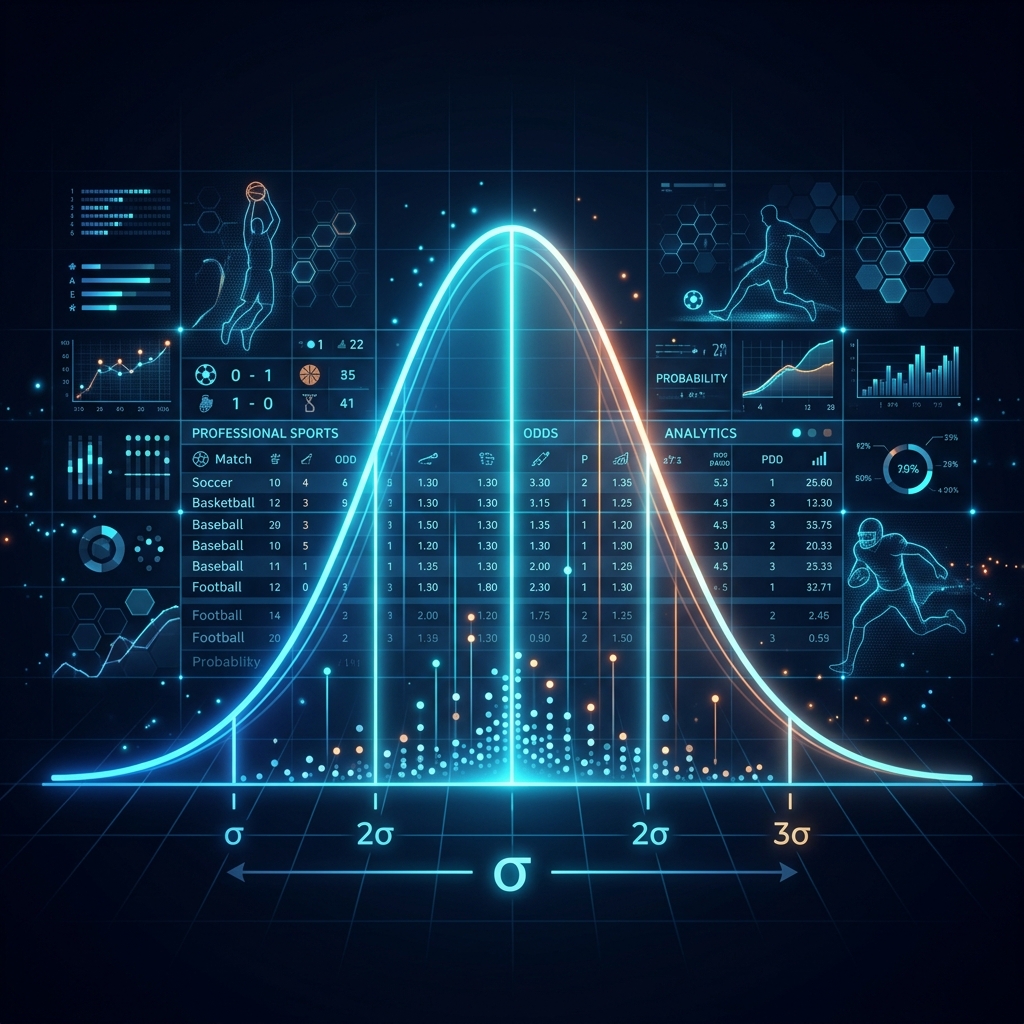
Standard deviation is a statistical measure that quantifies the amount of variation or dispersion in a set of values. In sports betting, it helps bettors understand the volatility of their bets and the likelihood of different outcomes. A low standard deviation indicates that the outcomes are close to the expected value, while a high standard deviation suggests a wide range of possible outcomes.
The Mathematics of Standard Deviation
To calculate standard deviation, you first need to determine the mean (average) of your data set. Then, subtract the mean from each data point and square the result. Find the average of these squared differences, and finally, take the square root of that average. Here’s the formula:
Formula: σ = √(Σ(xi - μ)² / N)
Where:
- σ is the standard deviation.
- Σ denotes the sum of the values.
- xi represents each value in the data set.
- μ is the mean of the data set.
- N is the number of values in the data set.
For example, if you place a $100 bet on a series of games with outcomes of $120, $80, $100, $110, and $90, the mean is $100. The squared differences are 400, 400, 0, 100, and 100. The average of these squared differences is 200, and the square root is approximately 14.14. Thus, the standard deviation is $14.14.
How Standard Deviation Works in Practice
Consider two sportsbooks offering different odds on the same event. Sportsbook A offers odds that result in a low standard deviation, meaning the outcomes are more predictable. Sportsbook B offers odds with a high standard deviation, indicating more volatility.
-
Sportsbook A: Offers odds of 1.9 on a $100 bet. Possible outcomes are $190 (win) or $0 (loss). The mean is $95, and the standard deviation is calculated as follows:
- Outcomes: $190, $0
- Mean: $95
- Squared differences: 9025, 9025
- Average of squared differences: 9025
- Standard deviation: √9025 ≈ $95
-
Sportsbook B: Offers odds of 3.0 on a $100 bet. Possible outcomes are $300 (win) or $0 (loss). The mean is $150, and the standard deviation is:
- Outcomes: $300, $0
- Mean: $150
- Squared differences: 22500, 22500
- Average of squared differences: 22500
- Standard deviation: √22500 ≈ $150
In this scenario, Sportsbook B has a higher standard deviation, indicating a riskier bet with potentially higher rewards.
Why Recreational Bettors Misunderstand Standard Deviation
Recreational bettors often overlook standard deviation, focusing solely on potential winnings without considering the volatility of their bets. They may misinterpret a high standard deviation as a sign of a better opportunity, not realizing it indicates greater risk. This misunderstanding can lead to poor bankroll management and unexpected losses.
How Professionals Exploit Standard Deviation for Profit
Sharp bettors leverage standard deviation to identify value bets and manage risk. By understanding the volatility of different bets, they can adjust their stakes to optimize expected value (EV) and minimize variance. Professionals often use standard deviation to calculate the closing line value (CLV), ensuring they consistently place bets with a positive expected return.
For example, a professional might use standard deviation to determine the optimal bet size, ensuring that their bankroll can withstand potential losses while maximizing profit potential. They may also use it to identify arbitrage opportunities, where the variance between different sportsbooks’ odds creates a guaranteed profit.
Standard Deviation Across Different Sports (NFL vs NBA vs Soccer)
| Sport | Typical Standard Deviation | Market Liquidity | Implications |
|---|---|---|---|
| NFL | Moderate | High | Predictable outcomes, lower variance in point spreads. |
| NBA | High | Moderate | High-scoring games lead to greater variance in totals. |
| Soccer | Low | Low | Low-scoring nature results in tighter odds and lower variance. |
Tools Needed to Capitalize on Standard Deviation
To effectively use standard deviation in sports betting, bettors need access to advanced analytics tools. Essential features include:
- Odds Comparison Software: To identify discrepancies between sportsbooks and potential arbitrage opportunities.
- Bet Tracking Tools: To monitor betting performance and calculate standard deviation over time.
- Statistical Analysis Software: To perform in-depth analysis of betting data, including variance and expected value calculations.
- Bankroll Management Systems: To adjust bet sizes based on calculated risk and standard deviation.
These tools enable bettors to make informed decisions, manage risk effectively, and maximize their potential for profit.